
Resources
- Certification of Passport Form
- Certification of Marriage Certificate Form
- STATUTORY DECLARATION Spouse of an Irish Citizen
- STATUTORY DECLARATION Civil Partner of an Irish Citizen
- Residential Proof Affidavit
- Passport Affidavit
- Birth Affidavit (Adult)
- Naturalisation Residency Calculator
- https://www.irishimmigration.ie/how-to-become-an-irish-citizen-guide/
What Is Irish Citizenship by Naturalisation?
Who Can Apply
Naturalisation may be available to:
Adults aged 18 or over who have built up sufficient lawful residence in Ireland.
Non-EEA nationals who entered Ireland on employment permits and have maintained valid immigration permission throughout their stay.
Spouses or civil partners of Irish citizens under a reduced residence requirement of 3 years, and must also provide joint proofs of address for the three months immediately preceding the application.
Children or minors, in specific, limited circumstances.
Residence Requirements Explained
To qualify for naturalisation under the standard residence route, an applicant must show:
One year of continuous residence immediately before applying, and
A total of four years’ reckonable residence in Ireland, overall 5.
During the final year before application, absences from the State are strictly limited:
Up to 70 days outside Ireland are permitted as a general rule.
A further 30 days may be disregarded at the discretion of the Minister, but only in exceptional circumstances.
Exceeding these limits can place an application at risk, even where overall residence is otherwise sufficient. In addition, if any of the four years of residence relied upon prior to the final year includes absences, applicants must simply deduct that time spent outside Ireland and ensure they still reach a total of 1,460 days of reckonable residence within the previous eight years.
Reckonable Residence and Immigration Stamps
Not all immigration permissions count towards reckonable residence for naturalisation.
As a general rule:
Stamps 1, 1G, 1A, 3, 4, and 5 are considered reckonable for naturalisation purposes.
Student or temporary permissions are generally not considered reckonable.
Any period during which an immigration permission has expired is also non-reckonable, and even short gaps can render an application ineligible.
The Good Character Requirement
All applicants must be assessed as being of good character. This assessment considers factors such as:
Criminal convictions or ongoing prosecutions.
Compliance with Irish immigration law.
Broader public interest considerations.
As part of this assessment, applicants are required to complete Garda vetting in the months following submission of the application.
Supporting Documents
Identity
To prove your identity, you must reach a score of 150 points using documents from the official identity scorecard.
| Document | Points | Notes |
| Certified colour copy of valid passport | 150 | Must be in date |
| Expired passport (<365 days) | 75 | Additional documents required |
| Expired passport (>365 days) | 50 | |
| Certified Irish Residence Permit (IRP) | 75 | |
| Driving licence (in date, with photo) | 10 | |
| Public Services Card | 25 | |
| PPS Letter (DSP/Employer) | 25 | |
| Certified National ID (EU Regulation compliant) | 50 | |
| Certificate of Identity, Red Cross, or UNHCR ID | 50 | Acceptable alternatives for some applicants |
- A single document that reaches 150 points (for example, a certified colour copy of the biometric page of your valid passport) is sufficient on its own.
- If you use multiple documents, their combined score must reach at least 150 points.
- Alongside your passport, you must submit a completed Passport Certification Form, confirming that the copy of your passport is a true copy of the original.
Residency
- Two Strong documents, or
- One Strong document and one Supporting document.
A Strong document is worth 100 points, and a Supporting document is worth 50 points.
Two Supporting documents cannot be combined to meet the 150-point requirement.
| Doc Type | Examples | Points |
| Strong | Bank statements (with min. 3 transactions/month for 3 months) | 100 |
| Strong | Employment Detail Summary (P60) or Revenue Statement | 100 |
| Strong | DSP Annual Contribution Statement | 100 |
| Strong | Letter from Employer (confirming dates) | 100 |
| Supporting | Utility Bill (gas, broadband, electricity) | 50 |
| Supporting | Phone Bill (mobile or landline) | 50 |
| Supporting | Rent agreement / tenancy letter | 50 |
| Supporting | Medical or hospital letter confirming address | 50 |
| Supporting | Credit card statement | 50 |
| Supporting | Letter from school, housing authority, IPAS, Direct Provision | 50 |
All proofs must show:
Your full name,
A residential address in Ireland, and
A date that falls within the year claimed.
If you cannot reach the required score for one or more years, you must complete the following in full, only in exceptional circumstances where a mandatory document truly cannot be reasonably obtained and upload it with your application:
A Residential Proof Affidavit, found here, explaining why you cannot provide the full proofs, and
Whatever other supporting documents you do have.
Certification
Copies of identity documents, particularly those used for identity scoring, must be certified by an appropriate official, such as a practising solicitor, peace commissioner, commissioner for oaths, or notary public. This includes:
A colour copy of the biometric page(s) of your current passport (as of 20th April 2023)
A copy of the birth certificate
A copy of the Marriage Certificate (for applications based on an Irish spouse or civil partner)
Statutory Declaration (for applications based on Irish spouse or civil partner)
Proofs of residence do not require certification, but they must be clear and legible. Failure to meet the scorecard thresholds or to provide complete and accurate information can lead to rejection of the application and forfeiture of the application fee.
Applications for naturalisation are submitted online through the Immigration Service Delivery system. An application fee of €175 is payable before processing begins.
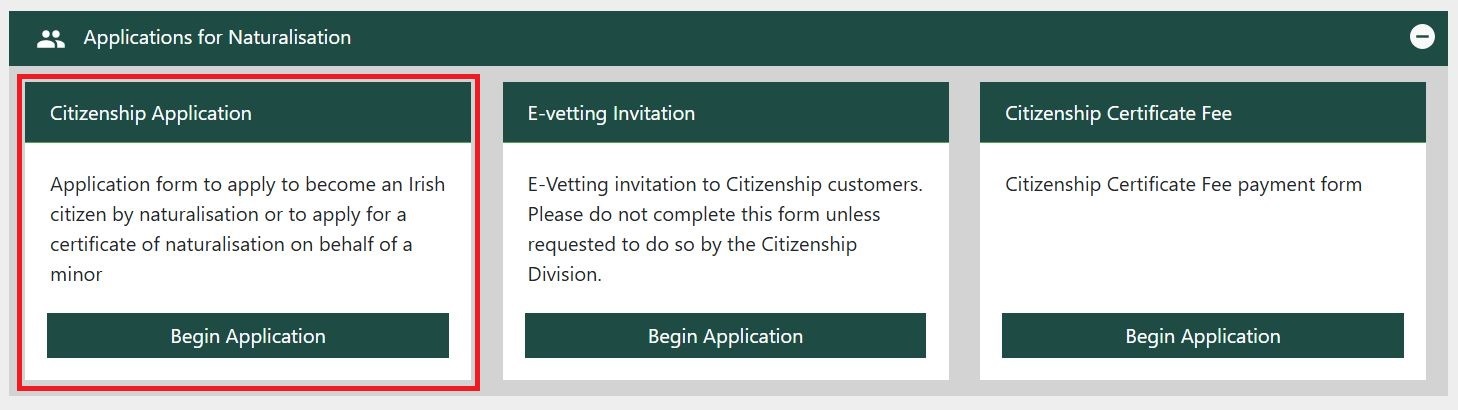
After submission and uploading all required documents, applications undergo several stages of assessment. In the months following submission, applicants are typically invited to complete Garda e-vetting, and additional documentation may be requested depending on individual circumstances. Upon approval of an application, a certification fee of up to €950 is payable.
You are then invited to make the Declaration of Fidelity to the Irish nation and loyalty to the State at a citizenship ceremony. An invitation is issued by post or email in advance of the scheduled ceremony. Attending the citizenship ceremony is the final step in the naturalisation process, and you may bring one adult guest with you on the day.
Processing Times and Decisions
Processing times vary, but many applications take around 12 months or longer from submission to decision. Delays may arise where residence evidence is incomplete or where additional checks are required.
Naturalisation decisions are made at the discretion of the Minister. There is no formal appeal process, but reasons for refusal are provided.
If an Application Is Refused
A refusal does not prevent a future application. In most cases, applicants may reapply once the issues identified in the refusal decision have been addressed, such as residence gaps or documentation deficiencies.
Why This Matters for Work Permit Holders

Book an Appointment
If you would like personalised advice and a more in-depth discussion about your individual circumstances, please book an appointment at a date and time that suits you. Once your booking is confirmed, you will receive the relevant appointment details by email.
Found this blog useful?
Please share it with your network or support our work here.
Stay up to date with our latest immigration news, guidance, and practical information by subscribing to our blog.